German Prepositions Explained: Accusative, Dative, and Two-Way Prepositions
By LangPodTools Team, Language Learning Content Specialist

German prepositions are one of those topics that makes learners go quiet and stare at the ceiling. You just figured out the four German cases — and now prepositions come along and tell you which case to use next.
Here is the good news: prepositions follow predictable rules. Once you group them correctly, the whole system clicks into place. This guide will show you exactly how.
What Are Prepositions and Why Do They Matter in German?
A preposition is a small word that connects a noun or pronoun to the rest of the sentence. Words like in, on, for, with, and through are prepositions in English.
In German, prepositions do one extra job: they require a specific grammatical case for the noun that follows them. This is not optional — it determines how you conjugate articles and adjectives throughout the sentence.
For example, mit (with) always takes the dative case. So you say mit dem Hund (with the dog), not mit der Hund or mit den Hund. Get the case wrong and native speakers will notice immediately.
The great shortcut? German prepositions fall into three clean buckets:
- Accusative-only prepositions
- Dative-only prepositions
- Two-way prepositions (accusative or dative depending on meaning)
Learn which bucket each word lives in, and the cases take care of themselves.
Accusative Prepositions
Accusative prepositions always take the accusative case — no exceptions, no special conditions. There are only five of them, which makes this group the easiest to memorize.
The Five Accusative Prepositions
| Preposition | Meaning | Example |
|---|---|---|
| durch | through | Wir fahren durch den Tunnel. (We drive through the tunnel.) |
| für | for | Das ist für meinen Bruder. (That is for my brother.) |
| gegen | against / around (time) | Er ist gegen die Wand gelaufen. (He walked into the wall.) |
| ohne | without | Sie geht ohne einen Regenschirm. (She goes without an umbrella.) |
| um | around / at (time) | Wir treffen uns um den Brunnen. (We meet around the fountain.) |
A popular mnemonic to remember these five: DGFOU — durch, für, gegen, ohne, um. Or try the phrase: "Dogs Go For Old Umbrellas."
Study Tip: Write each accusative preposition on a flashcard with one example sentence in your own life. "Ich kaufe das für meinen Vater" sticks better than a random textbook sentence. Use our Flashcard Tool to build your deck in minutes.
Accusative Prepositions in Real Sentences
- Ich lerne Deutsch für meine Arbeit. — I am learning German for my job.
- Der Zug fährt durch die Stadt. — The train goes through the city.
- Er kommt ohne seinen Freund. — He comes without his friend.
- Sie läuft um den Park. — She runs around the park.
- Wir sind gegen den Plan. — We are against the plan.
Dative Prepositions
Dative prepositions always take the dative case. There are seven core ones. This group is larger, but the words are extremely common — you will use them every single day.
The Seven Dative Prepositions
| Preposition | Meaning | Example |
|---|---|---|
| aus | from / out of | Sie kommt aus der Schweiz. (She is from Switzerland.) |
| bei | at / near / with (at someone's place) | Er wohnt bei seiner Tante. (He lives with his aunt.) |
| mit | with | Ich fahre mit dem Bus. (I go by bus.) |
| nach | after / to (cities, countries) | Wir fliegen nach Berlin. (We fly to Berlin.) |
| seit | since / for (time) | Sie lernt Deutsch seit einem Jahr. (She has been learning German for a year.) |
| von | from / by / of | Das ist ein Brief von meiner Mutter. (That is a letter from my mother.) |
| zu | to (people, places) | Ich gehe zum Arzt. (I am going to the doctor.) |
A common mnemonic: "Aus bei mit nach seit von zu" — say it like a little chant until it becomes automatic. Many learners set it to a rhythm or melody.
Dative Prepositions in Real Sentences
- Ich trinke Kaffee mit Milch. — I drink coffee with milk.
- Er kommt nach dem Unterricht. — He comes after class.
- Sie wohnt bei ihren Eltern. — She lives with her parents.
- Ich habe das von meinem Freund gehört. — I heard that from my friend.
- Wir wohnen hier seit drei Jahren. — We have lived here for three years.
Study Tip: Seit is a false friend for English speakers. It translates as "for" or "since" but requires the present tense in German — not the perfect tense. Ich lerne Deutsch seit zwei Jahren means "I have been learning German for two years." English uses present perfect; German uses simple present. This trips up nearly every A2-B1 learner.
Two-Way Prepositions
This is where it gets interesting. Two-way prepositions (also called Wechselpräpositionen) can take either accusative or dative — depending on what you mean.
The rule is clean and logical:
- Accusative = motion toward a destination (answering wohin? — where to?)
- Dative = location or rest (answering wo? — where?)
The Nine Two-Way Prepositions
| Preposition | Meaning |
|---|---|
| an | at / on (vertical surfaces) |
| auf | on (horizontal surfaces) |
| hinter | behind |
| in | in / into |
| neben | next to |
| über | above / over |
| unter | under / below |
| vor | in front of / before |
| zwischen | between |
Accusative vs. Dative — Side by Side
| Question | Case | Example |
|---|---|---|
| Wohin? (Where to?) | Accusative | Ich hänge das Bild an die Wand. (I hang the picture on the wall.) |
| Wo? (Where?) | Dative | Das Bild hängt an der Wand. (The picture hangs on the wall.) |
| Wohin? | Accusative | Sie legt das Buch auf den Tisch. (She puts the book on the table.) |
| Wo? | Dative | Das Buch liegt auf dem Tisch. (The book is lying on the table.) |
| Wohin? | Accusative | Er geht in die Stadt. (He goes into the city.) |
| Wo? | Dative | Er ist in der Stadt. (He is in the city.) |
The key verbs that signal movement — gehen, legen, stellen, hängen, fahren, laufen — tend to pair with accusative. Verbs of state — sein, liegen, stehen, hängen (to be hanging) — pair with dative.
Study Tip: Think of two-way prepositions as a traffic light. Red = dative (stop, you are there). Green = accusative (go, you are moving). When you picture the sentence, ask yourself: is someone moving somewhere, or are they already there?
Contractions You Need to Know
In everyday spoken and written German, prepositions frequently contract with the definite article. These are not slang — they are standard grammar.
Common Contractions
| Long Form | Contraction | Example |
|---|---|---|
| in + dem | im | Er ist im Supermarkt. |
| an + dem | am | Wir treffen uns am Bahnhof. |
| in + das | ins | Sie geht ins Kino. |
| an + das | ans | Das Schiff fährt ans Meer. |
| zu + dem | zum | Ich gehe zum Arzt. |
| zu + der | zur | Wir fahren zur Schule. |
| von + dem | vom | Er kommt vom Markt. |
| bei + dem | beim | Sie ist beim Friseur. |
Using the full form (in dem instead of im) is technically not wrong, but it sounds unnatural and stiff. Native speakers use contractions automatically.
Prepositional Verbs — When Verbs Choose Their Own Preposition
Some German verbs lock onto a specific preposition to complete their meaning. These prepositional verbs require you to memorize the pairing as one unit.
The preposition in these phrases does not follow movement/location logic — the verb simply demands it. Check the conjugation tool to practice these verb forms.
Common Prepositional Verbs
- warten auf (+ accusative) — to wait for → Ich warte auf den Bus. (I am waiting for the bus.)
- denken an (+ accusative) — to think about → Sie denkt an ihre Eltern. (She thinks about her parents.)
- sprechen über (+ accusative) — to talk about → Wir sprechen über das Wetter. (We talk about the weather.)
- sich freuen auf (+ accusative) — to look forward to → Ich freue mich auf den Urlaub. (I look forward to the vacation.)
- sich freuen über (+ accusative) — to be happy about → Er freut sich über das Geschenk. (He is happy about the gift.)
- bitten um (+ accusative) — to ask for → Sie bittet um Hilfe. (She asks for help.)
- zweifeln an (+ dative) — to doubt → Er zweifelt an sich selbst. (He doubts himself.)
- leiden unter (+ dative) — to suffer from → Sie leidet unter dem Stress. (She suffers from the stress.)
Notice that sich freuen auf and sich freuen über are two different expressions with two different meanings. This is exactly why you must learn these as fixed pairs, not guess the preposition from meaning alone.
Common Prepositional Phrases and Idioms
Beyond grammar rules, prepositions appear in fixed idiomatic expressions. These are worth learning as vocabulary chunks rather than analyzing word by word.
- im Allgemeinen — in general
- auf jeden Fall — in any case / definitely
- von Anfang an — from the beginning
- mit der Zeit — over time / with time
- am besten — best (superlative with am)
- zum Beispiel (z.B.) — for example
- unter anderem (u.a.) — among other things
- an sich — in itself / per se
- auf einmal — suddenly / all at once
- im Moment — at the moment
You will encounter these constantly in German podcasts and audio content. Recognizing them as fixed units speeds up listening comprehension enormously.
Common Mistakes to Avoid
Even intermediate learners make these errors. Knowing them in advance saves you weeks of building bad habits.
-
Using accusative after dative-only prepositions. Mit meinen Freunden (dative) — not mit meine Freunde. The preposition decides; the noun follows.
-
Forgetting two-way preposition logic. Saying Ich bin in die Küche when you mean "I am in the kitchen." Motion = accusative (Ich gehe in die Küche). Location = dative (Ich bin in der Küche).
-
Translating English prepositions directly. German and English prepositions rarely match one-to-one. Interested in = interessiert an (not interessiert in). Angry at = wütend auf (not wütend an). Always check the German pairing.
-
Skipping contractions. Saying in das Kino instead of ins Kino marks you as a textbook learner. Use contractions from day one.
-
Confusing nach and zu. Both mean "to" but in different contexts. Nach is for cities and countries without an article (nach Berlin, nach Deutschland). Zu is for people and specific places (zum Bahnhof, zur Lehrerin).
Pair this article with our guide on German word order rules — prepositions and word order interact constantly, especially in subordinate clauses.
Practice Table: Test Yourself
Fill in the correct form of the article for each sentence. Answers below.
| Sentence | Missing Word |
|---|---|
| Wir gehen in ___ Supermarkt. (direction) | den |
| Wir sind in ___ Supermarkt. (location) | dem |
| Das Buch ist für ___ Lehrerin. | die |
| Er kommt aus ___ Schweiz. | der |
| Sie läuft um ___ Park. | den |
| Das Café ist neben ___ Bibliothek. (location) | der |
For more vocabulary practice, see our list of essential German words — many appear in prepositional phrases you will use immediately.
Recommended Resources
If you want structured practice beyond reading, these resources give you audio, exercises, and visual explanations that reinforce what you learned here. Check the German learning hub for our full recommendations.
Study Tip: Grammar study alone will not make prepositions automatic. You need repeated input — reading, listening, and speaking. Aim for 80% input, 20% deliberate grammar drilling. German podcasts are ideal for absorbing prepositions in natural context. Find your level at LangPodTools.
Wrapping Up
German prepositions look intimidating at first, but the underlying logic is tight and learnable. Memorize the accusative five. Chant the dative seven. Apply the motion/location test to two-way prepositions. Use contractions from day one.
Do that consistently and you will stop second-guessing cases whenever a preposition appears. Instead, you will reach for the right form automatically — exactly the way fluent speakers do.
For a broader foundation, revisit German cases explained and combine it with German word order rules. Prepositions, cases, and word order are the three pillars of German sentence structure — master all three together.
Frequently Asked Questions
How do I know which case to use after a two-way preposition?▾
What is the easiest way to memorize accusative prepositions?▾
What is the difference between 'nach' and 'zu' when saying 'to' in German?▾
Do I always have to use contractions like 'im' and 'zum' in German?▾
Recommended Study Material
The Complete German Grammar Cheat Sheet
A1–B2 Reference PDF
27 pages of color-coded tables, mnemonics, and shortcuts — every rule you need from Cases to Subjunctive.
Recommended German Books

Short Stories in German for Beginners
Olly Richards
Learn German with 8 captivating stories. Perfect for A2-B1 learners who want to build vocabulary naturally.
Check Price on Amazon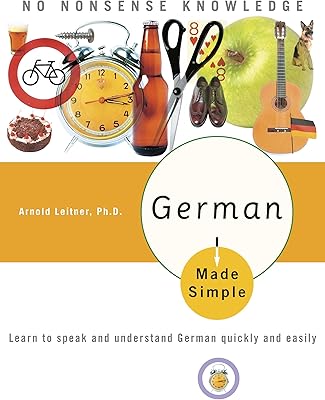
German Made Simple
Eugene Jackson
A complete beginner's guide covering grammar, vocabulary, and conversation essentials.
Check Price on Amazon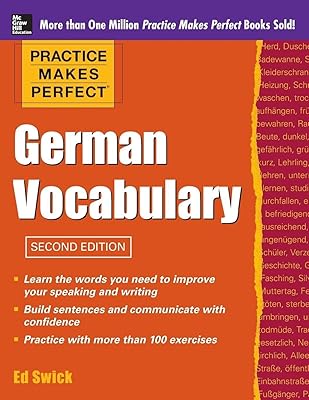
Practice Makes Perfect: German Vocabulary
Ed Swick
Targeted exercises and drills for mastering essential German words and phrases.
Check Price on AmazonAs an Amazon Associate, we earn from qualifying purchases.