German for Beginners: Your Complete Starter Guide
By LangPodTools Editorial Team, Language Learning Content Specialist

Starting to learn German can feel overwhelming. You've got umlauts, long compound words, and three grammatical genders staring you down. But here's the truth: German is one of the most learnable languages for English speakers, and you can make real, noticeable progress in just a few weeks.
This guide covers everything you need as a complete beginner — from your first German words to study habits that actually stick.
Why Learn German?
German is the most widely spoken language in Europe, with over 100 million native speakers. It's the official language of Germany, Austria, and Switzerland. That's a lot of doors waiting to open.
Here are a few more reasons to get started:
- Career opportunities: Germany is Europe's largest economy. German skills are a real advantage in business, engineering, and science.
- Travel: Getting around Germany, Austria, or Switzerland is much easier when you speak the language.
- Culture and history: Goethe, Kafka, Einstein, and Beethoven all worked in German. Some of humanity's greatest ideas live in this language.
- It's closer to English than you think: Both languages share Germanic roots. Words like Haus (house), Wasser (water), Brot (bread), and gut (good) feel instantly familiar.
You already know more German than you realize. That's a huge head start.
How Hard Is German for English Speakers?
The Foreign Service Institute classifies German as a Category II language — roughly 750 classroom hours to reach professional proficiency. That's more than Spanish, but far less than Mandarin or Arabic.
Here's an honest breakdown of the tricky parts:
| Challenge | Difficulty | Quick Tip |
|---|---|---|
| Grammatical gender (der/die/das) | Hard | Always learn the article WITH each noun |
| Case system (nominative, accusative, dative) | Hard | Master nominative + accusative first |
| Long compound words | Medium | Break them into smaller parts |
| Verb conjugation | Medium | Start with regular verbs only |
| Pronunciation | Easy–Medium | Spelling is phonetically consistent |
The big upside? German spelling is extremely logical. Once you learn how letters sound, you can read any German word out loud — something English never gives you.
Where to Start: German for Beginners Step by Step
Step 1: Learn the Alphabet and Key Sounds
German uses the same alphabet as English, plus four extra characters: ä, ö, ü, and ß. Spend one session getting comfortable with these.
Key sounds to know:
- ä — like the "e" in bed
- ö — round your lips and try to say "e" — similar to "ur" in burn
- ü — round your lips and try to say "ee"
- ß — a double "s" sound (Straße = street)
German vowels are consistent. Once you know the rules, you'll never be caught off guard by a word's pronunciation.
Step 2: Learn the Most Common Words First
Don't try to memorize the dictionary. Focus on the 100 most common German words — they cover about 50% of everyday speech.
Here are the essentials to start with:
| German | English | Pronunciation |
|---|---|---|
| Hallo | Hello | HAL-oh |
| Danke | Thank you | DAHN-keh |
| Bitte | Please / You're welcome | BIT-teh |
| Ja / Nein | Yes / No | yah / nine |
| Entschuldigung | Excuse me / Sorry | ent-SHOOL-dee-goong |
| Wie heißt du? | What's your name? | vee HIGHST doo |
| Ich heiße… | My name is… | ikh HIGH-seh |
| Wo ist…? | Where is…? | voh ist |
These phrases cover real situations immediately — cafés, transport, introductions.
Step 3: Understand Basic Sentence Structure
German main clauses follow the same Subject–Verb–Object pattern as English:
Ich esse einen Apfel. (I eat an apple.)
The tricky part? In subordinate clauses, the verb moves to the end:
Ich weiß, dass er einen Apfel isst. (I know that he eats an apple.)
Don't overthink this at the start. Get comfortable with simple sentences, and the grammar patterns will start to click naturally over time.
Essential German Phrases for Daily Life
Here are phrases you'll use constantly — memorize these before anything else.
Greetings:
- Guten Morgen — Good morning
- Guten Tag — Good day / Hello (formal)
- Guten Abend — Good evening
- Auf Wiedersehen — Goodbye (formal)
- Tschüss — Bye (informal)
At a café or restaurant:
- Ich hätte gerne… — I would like…
- Die Rechnung, bitte. — The bill, please.
- Was empfehlen Sie? — What do you recommend?
Getting around:
- Wo ist der Bahnhof? — Where is the train station?
- Wie komme ich zum…? — How do I get to…?
Shopping:
- Was kostet das? — How much does this cost?
- Ich schaue nur. — I'm just looking.
For a deeper dive into conversational German, check out our complete guide to 50 Common German Phrases for Everyday Conversations.
German Grammar Basics (Without the Overwhelm)
The Three Genders
Every German noun has a gender: masculine (der), feminine (die), or neuter (das). There's no perfect logic — you memorize the gender with each word.
The golden rule: always learn nouns with their article. Don't just know Hund (dog). Know der Hund.
Some endings do give you hints:
- Words ending in -ung are almost always feminine — die Wohnung (apartment)
- Words ending in -chen are always neuter — das Mädchen (girl)
- Words ending in -er (people/roles) are usually masculine — der Lehrer (teacher)
The Case System
German has four grammatical cases. For beginners, focus on just two:
- Nominative — the subject (Der Hund schläft. — The dog is sleeping.)
- Accusative — the direct object (Ich sehe den Hund. — I see the dog.)
Dative and genitive come later. Don't let the full case system stop you before you've started.
Once you're comfortable with the basics, our guide to All 6 German Tenses Explained is the perfect next step for building real fluency.
Common Mistakes German Beginners Make
Learning from other people's mistakes saves you months of frustration.
1. Skipping noun genders Writing der Mädchen instead of das Mädchen is a classic error. Learn genders from day one — it's much harder to unlearn bad habits later.
2. Using "du" with strangers German has formal (Sie) and informal (du) versions of "you." Use Sie with adults you don't know, professionals, and shopkeepers. Switch to du only when they invite it.
3. Getting the "ch" sound wrong German ch has two sounds:
- After a, o, u: a guttural sound (like clearing your throat) — Buch (book)
- After e, i, ä, ö, ü: a softer hiss — ich (I)
4. Translating idioms word for word Das ist nicht mein Bier literally means "that's not my beer" — but it means "that's not my problem." German idioms need to be learned as chunks, not decoded.
5. Ignoring listening practice Reading German is much easier than understanding spoken German. Add listening from week one, even if you only catch a few words per sentence.
Funny German Words Worth Knowing
German is famous for creative compound words that describe things other languages need whole sentences for.
| German Word | Literal Translation | Real Meaning |
|---|---|---|
| Fingerspitzengefühl | Fingertip feeling | Intuition / sensitivity |
| Verschlimmbessern | To worsen by improving | Making things worse while trying to help |
| Torschlusspanik | Gate-closing panic | Fear of missing out as time runs out |
| Weltschmerz | World pain | Deep sadness about the state of the world |
| Kummerspeck | Grief bacon | Weight gained from emotional eating |
And some idioms that'll make you laugh:
- Ich verstehe nur Bahnhof — "I only understand train station" = I have no idea what you're saying.
- Jemandem auf den Keks gehen — "To walk on someone's cookie" = To get on someone's nerves.
These quirky phrases are great memory anchors — and they make conversations more fun.
The Best Tools for Learning German
Podcasts and Audio (Your Secret Weapon)
Podcasts train your ear for real German speech, and you can listen anywhere. They're especially powerful combined with a textbook or app.
Top picks for beginners:
- Coffee Break German — bite-sized structured lessons, very beginner-friendly
- Slow German — native speaker, slowed down, with transcripts
- Deutsch Warum Nicht? (Deutsche Welle) — free, structured, like a radio course
- GermanPod101 — structured lessons with cultural notes
Aim for 20–30 minutes of German audio daily. Consistency is everything.
Apps That Actually Work
| App | Best For | Cost |
|---|---|---|
| Duolingo | Daily habit building | Free (Premium available) |
| Babbel | Grammar-focused learners | Paid subscription |
| Anki | Vocabulary via flashcards | Free |
| Pimsleur | Audio-first learners | Paid subscription |
| Clozemaster | Bridging beginner to intermediate | Free + Premium |
No single app is enough on its own. The best approach: one app + one podcast + one textbook.
Get a Good Textbook
Apps can't replace the structure of a solid beginner textbook. Look for ones with audio components so you can hear what you're learning.
Our full breakdown is in Best German Books for Beginners: Textbooks, Stories, and Study Guides — a must-read if you want a structured path.
Watch German Video Content
- Easy German (YouTube) — street interviews with dual-language subtitles
- Deutsche Welle YouTube — free news and beginner lessons
- Nicos Weg (ARD Mediathek) — a free beginner video series with full transcripts
Even 15 minutes of German video daily makes a measurable difference within a month.
Your First-Week German Study Plan
Here's a simple schedule to build momentum without burning out:
| Day | Activity | Time |
|---|---|---|
| Monday | Learn alphabet + special characters | 20 min |
| Tuesday | 20 essential words + greeting phrases | 20 min |
| Wednesday | Basic sentence structure + practice | 20 min |
| Thursday | Coffee Break German Episode 1 + notes | 25 min |
| Friday | Flashcard review (Anki) | 15 min |
| Saturday | Watch Easy German video + note new words | 20 min |
| Sunday | Conversation practice or full review | 20 min |
Total: about 2.5 hours in week one. That's all you need to start building real momentum.
German Culture: Context Makes Language Stick
Language and culture are inseparable. Knowing a few cultural cues helps you communicate more naturally — not just grammatically.
Punctuality matters a lot. Being late is considered disrespectful. If you're meeting a German-speaking person, arrive on time.
Direct communication is the norm. Germans tend to be straightforward. What sounds blunt in English may just be honest in German — don't read too much into it.
Bread is a cultural institution. Germany has over 3,000 registered bread varieties. Sunday bakery trips (Bäckerei) are a real ritual. Knowing bread vocabulary will genuinely impress locals.
Titles matter in formal settings. Use Herr (Mr.) or Frau (Ms./Mrs.) plus a surname in professional contexts until you're invited to switch to first names.
These small cultural details make your German feel human rather than textbook-perfect.
How Long Does It Take to Reach Each Level?
| Level | What You Can Do | Estimated Study Hours |
|---|---|---|
| A1 | Introduce yourself, order food, basic phrases | 80–100 hours |
| A2 | Handle simple daily situations confidently | 180–200 hours |
| B1 | Navigate most travel and work situations | 350–400 hours |
| B2 | Study or work in German comfortably | 600–700 hours |
If you study 30 minutes a day, you'll reach A1 in roughly 5–6 months. Push to 45–60 minutes and you're there in 3–4 months.
The single most important factor isn't how long you study each session — it's showing up every day. Five consistent days a week beats a weekend marathon every time.
Frequently Asked Questions
Can I learn German for free?▾
How long does it take to learn German as a beginner?▾
Is German hard to learn for English speakers?▾
What is the best app for learning German as a beginner?▾
What are the most important German phrases for beginners?▾
What is the difference between du and Sie in German?▾
Should beginners learn German grammar rules first or just start speaking?▾
Recommended Study Material
The Complete German Grammar Cheat Sheet
A1–B2 Reference PDF
27 pages of color-coded tables, mnemonics, and shortcuts — every rule you need from Cases to Subjunctive.
Recommended German Books

Short Stories in German for Beginners
Olly Richards
Learn German with 8 captivating stories. Perfect for A2-B1 learners who want to build vocabulary naturally.
Check Price on Amazon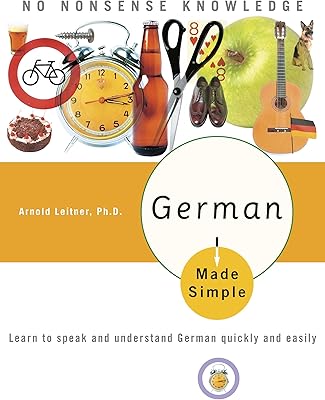
German Made Simple
Eugene Jackson
A complete beginner's guide covering grammar, vocabulary, and conversation essentials.
Check Price on Amazon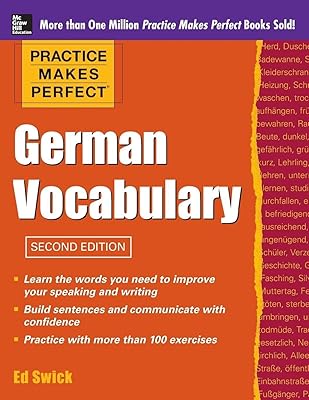
Practice Makes Perfect: German Vocabulary
Ed Swick
Targeted exercises and drills for mastering essential German words and phrases.
Check Price on AmazonAs an Amazon Associate, we earn from qualifying purchases.